

Today (26 January) is Republic Day in India. The staff in the restaurant were wearing badges of the Indian flag to mark the occasion. It’s interesting to read how the Indian flag contains a lot of symbolism and its use is quite controlled.
Wikipedia informs me that before the amendment of the ‘flag code’ in 2021, the flag was by law only to be made of khadi; a special type of hand-spun cloth or silk, made popular by Mahatma Gandhi. As of 2023, there are 4 places in India that are licensed to manufacture the flag. Usage of the flag is governed by the Flag Code of India and other laws relating to the national emblems. The original code prohibited use of the flag by private citizens except on national days, such as the Independence Day and the Republic Day. In 2002, the Supreme Court of India directed the Government of India to amend the code to allow flag usage by private citizens. Subsequently, the Union Cabinet of India amended the code to allow limited usage. The code was amended once more in 2005 to allow some additional use including adaptations on certain forms of clothing. The flag code also governs the protocol of flying the flag and its use in conjunction with other national and non-national flags.

The current Indian flag with the central Ashok Chakra was designed by Badruddin Tyabji in 1947. Gandhi first proposed a flag to the Indian National Congress in 1921. The precursor to the current flag, the swaraj flag was designed by Pingali Venkayya. In the centre was a traditional spinning wheel, symbolising Gandhi’s goal of making Indians self-reliant by fabricating their own clothing, between a red stripe for Hindus and a green stripe for Muslims. The design was then modified to replace red with saffron and to include a white stripe in the centre for other religious communities (as well to symbolise peace between the communities) and provide a background for the spinning wheel. However, to avoid sectarian associations with the colour scheme, the three bands were later reassigned new meanings: courage and sacrifice, peace and truth, and faith and chivalry respectively.
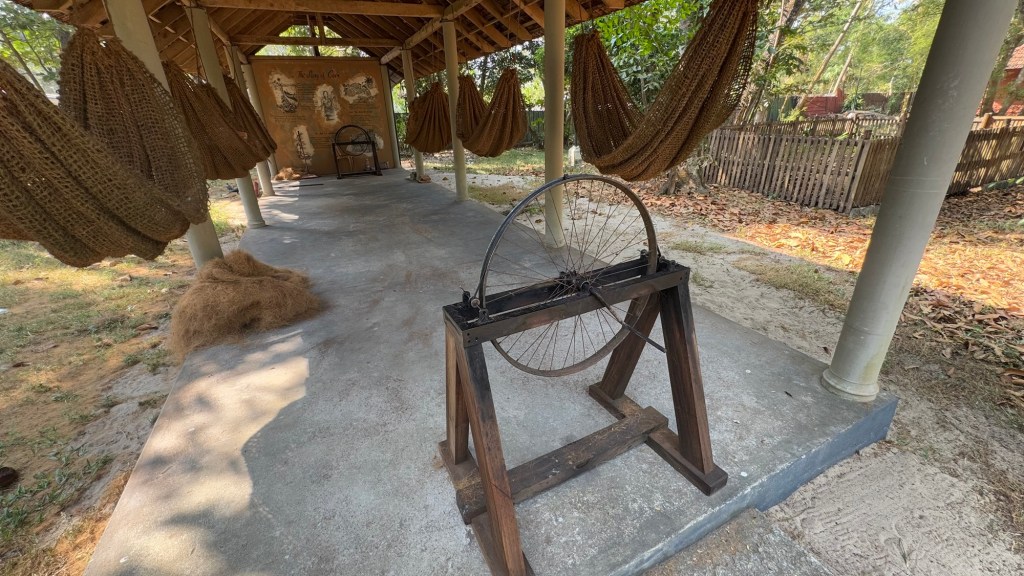
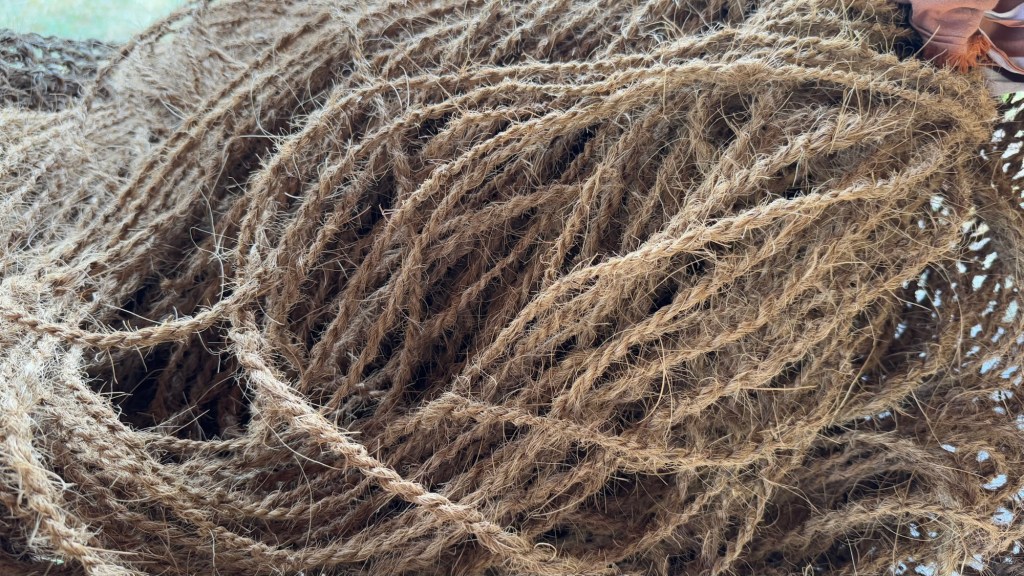
As someone who trained in textile design hearing about the type of cloth prescribed for the flag and the symbolism of the spinning wheel at its centre is facinating. Here at Marari Beach there is a spinning wheel used in the creation of a different kind of yarn. In the Coir Hut it’s possible to see how the coconut fibres are spun into yarn and then turned into coir rope, mats etc. Coir is a very tough and hard wearing fibre – we have had coir carpet in our hall in the past. For the women spinning it, it will certainly toughen up their hands!


 Matthew and Mike Travel from Bristol